FACET JOINT CALCIFICATION

Endoscopic RFA

Next-generation spinal calcification treatment that targets facet joint nerve branches one by one under HD camera guidance. Much safer, more effective and significantly longer-lasting than standard RFA.

Ultra Safe
100% Target-Focused
Clear Solution
Summary: Camera-guided calcification treatment (camera-guided RFA) is a non-surgical closed method that treats pain caused by spinal calcification using target-focused radiofrequency energy under a 3mm HD camera. Unlike conventional RFA, the camera visualisation makes the procedure significantly safer and more effective. Patients are discharged the same day. Op. Dr. Tunc Koc is one of the first surgeons in Turkey to perform this technique.

What Is Endoscopic RFA?

The new camera-guided calcification treatment is a spinal calcification therapy that targets facet joint nerve branches under HD camera guidance — much safer and more effective than standard radiofrequency ablation (RFA).

After the age of 50–60 in particular, the primary cause of low back pain is facet joint calcification. Op. Dr. Tunc Koc applies this technique as a pioneer in Turkey.
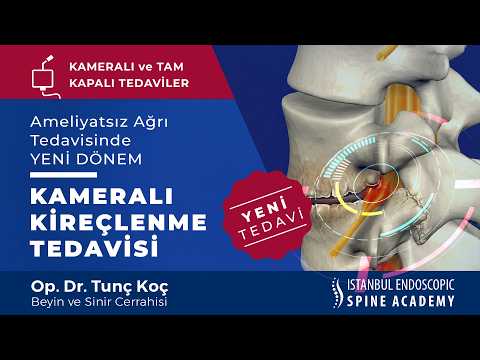
Camera-Guided Calcification Treatment (RFA) — Op. Dr. Tunc Koc

How It Differs from Standard RFA

Conventional radiofrequency ablation was applied under fluoroscopy, targeting nerve branches without direct visualisation — relying on estimation. In calcified joints, 50–70 fluoroscopic images may be required, which means high radiation exposure for both the patient and the medical team.

With the new camera-guided system, the inside of the facet joint is monitored with live HD imagery, the small nerve branches are located one by one, and radiofrequency energy is applied to the precise target.

Minimal Radiation

Very few X-ray images are taken — safe for both the patient and the medical team

Nerve Branches Are Seen

Precise targeting — not estimation

Long-Lasting Effect

Thanks to precise targeting, pain control lasts much longer — in some patients for years

Adjacent Structures Protected

Main nerve roots, vessels and the spinal cord are protected under continuous live monitoring

How Is the Procedure Performed?

1. Local Anaesthesia

No general anaesthesia is administered. Only local anaesthesia is applied to the procedure site. The patient remains awake and feels no pain.

2. Placing the Camera System

Using a minimally invasive technique, the camera system is advanced into the facet joint. The HD camera provides live imagery on a large screen.

3. Locating the Nerve Branches

With crystal-clear on-screen imagery, the nerve branches are located one by one. No estimation — precise identification.

4. Radiofrequency Ablation

Radiofrequency energy is applied to the precise target under visual control. The nerve branches are deactivated in a controlled manner.

Camera-Guided Calcification Treatment (Endoscopic RFA) — Op. Dr. Tunc Koc

Who Is It Suitable For?

  • Patients over 50 with chronic low back pain
  • Patients diagnosed with facet joint calcification
  • Patients who have not obtained sufficient benefit from physiotherapy and medication
  • Patients who do not want surgery but are seeking an effective solution
  • Patients who have responded positively to diagnostic injections
Questions to ask before treatment: "Will this procedure be performed with a camera?" and "Will you be able to see inside the facet joint?" — Two completely different methods are performed under the same procedure name.
More Information

Detailed Information

Find more information about camera-guided calcification treatment on the relevant page of Op. Dr. Tunc Koc's clinical website.

Go to Camera-Guided Calcification Treatment Page →

About Endoscopic RFA

What is the difference between camera-guided calcification treatment and standard RFA?
Standard RFA is performed under fluoroscopy with estimation, whereas the camera-guided method uses an HD camera to see directly inside the facet joint. Nerve branches are not estimated — they are seen individually and precisely targeted.
Is camera-guided calcification treatment painful?
No. It is performed under local anaesthesia and the patient feels no pain throughout the procedure.
How long does camera-guided calcification treatment take?
It generally takes 20–45 minutes.
When can the patient return to normal life after the procedure?
Patients are generally discharged the same day and can return to their daily activities in a short time.
How long does the effect of camera-guided calcification treatment last?
Because the nerve is completely deactivated under visual control, the effect lasts much longer than standard RFA. In some patients it may last for years.

Get Expert Opinion for Spinal Calcification

Op. Dr. Tunc Koc is one of Turkey's leading endoscopic spine surgeons. Get an expert consultation to evaluate your condition.