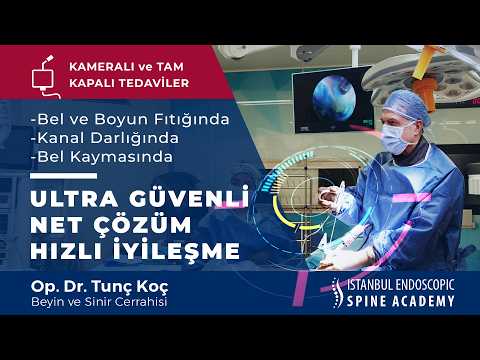
FULL ENDOSCOPIC · TRULY CLOSED SURGERY

What Is Endoscopic Spine Surgery?

Medically known as "full endoscopic" and colloquially as scarless and sutureless surgery, full endoscopic surgery refers exclusively to procedures performed with an endoscope system. Surgeries performed with a microscope are not truly closed surgery.

A few mm incision
Zero muscle damage
No screws · No plates
Fast Recovery
Summary: Endoscopic surgery (full endoscopic surgery) is a truly closed surgical method performed through a single 8–10 mm incision using fine instruments with an HD camera at the tip, without touching muscles or healthy tissues. Surgeries performed with a microscope or other methods are not truly closed; muscles are still opened and retracted. In endoscopic surgery, blood loss is minimal, patients can walk a few hours after surgery and the vast majority are discharged the same day.
What Is Endoscopic Surgery? Scarless Sutureless Full Endoscopic Surgery — Op. Dr. Tunc Koc
Op. Dr. Tunc Koc explains

What Is Truly Closed Surgery?

Procedures performed with this system we call an endoscope are referred to in many parts of the world as scarless surgery or sutureless surgery. In medical terminology they are called full endoscopic, and in everyday language full endoscopic or truly closed surgery.

Surgeries performed with other systems — especially those performed with a microscope — are not closed surgery. The microscopic method provides external magnification but still requires muscle retraction and tissue manipulation.

Using the camera and fine instruments at the tip of the endoscope, the desired area is reached without cutting muscles or damaging bones. If you compare the instruments to a pen, you can see how thin they are and how little harm they cause to the patient.

Full Endoscopic or Not?

Not all surgeries are truly closed. The difference is critical.

✅ Full Endoscopic Surgery (Endoscopic)

  • Medical name: Full Endoscopic Surgery
  • Internal visualisation via camera system
  • Single incision of a few millimetres
  • Zero muscle damage
  • Bones are not unnecessarily removed
  • No screws / plates required
  • Negligible bleeding
  • Very low infection risk
  • Often no sutures needed
  • Walking the same day, usually home the same day

❌ Microsurgery (NOT truly closed)

  • Medical name: Microscopic Surgery / MIS
  • External magnification with a microscope
  • Muscles must be retracted
  • Larger incision required
  • Bone and tissue damage possible
  • Screws / plates used more frequently
  • Higher bleeding risk
  • Longer recovery period
  • Sutures required
  • Longer hospital stay
Important note: Terms such as "laparoscopic", "minimally invasive" or "microsurgery" are sometimes described as closed surgery. However, in spine surgery the only truly closed method is full endoscopic surgery. Before choosing any method, we recommend asking your doctor: "Is this surgery fully endoscopic?"

Advantages of Endoscopic Surgery

Zero Muscle Damage

Thanks to the fine instruments and camera system, muscles are never cut during surgery. This dramatically reduces post-operative pain and recovery time.

No Screws or Plates Needed

Even in surgeries entering the spinal canal, there is no need to unnecessarily insert screw and plate systems. The natural spinal structure is preserved.

Negligible Bleeding

In the era of open surgery, several units of blood had to be prepared. With endoscopic surgery, these procedures are now performed with virtually no bleeding.

Very Low Infection Risk

Due to the small incision area and closed system, the probability of the surgical site becoming infected is extremely low.

Walking and Discharge the Same Day

Patients are helped to stand and walk a few hours later. Most patients are sent home the same day.

Sutureless Surgery

Since the incision is only a few millimetres, sutures are usually not needed at all. A symbolic suture may be used only for patients who need to travel long distances.

Which Conditions Can Be Treated?

Wide Range of Applications

Endoscopic surgery is now safely applied in the vast majority of spinal conditions. Op. Dr. Tunc Koc has performed over 3,500 endoscopic surgeries since 1989.

Endoscopic spine surgery applications — Op. Dr. Tunc Koc, Istanbul

About Endoscopic Surgery

What is the difference between endoscopic surgery and microsurgery?
Endoscopic surgery, also known as full endoscopic surgery, is a truly closed surgical method performed through only a few millimetre incision using a camera system. Microsurgery, on the other hand, is an open surgical technique that uses an external microscope for magnification and requires muscle retraction. Therefore, microsurgery is not truly closed surgery.
What does full endoscopic surgery mean?
Medically termed "full endoscopic", this method is also known colloquially as scarless surgery, sutureless surgery, full endoscopic or truly closed surgery. Only procedures performed with an endoscope qualify. Surgeries performed with a microscope or other methods are not considered closed surgery.
Are muscles cut during endoscopic surgery?
No. Thanks to the camera and fine instruments at the tip of the endoscope, the target area is reached without cutting muscles or damaging bones. This is the greatest advantage compared to conventional or microscopic surgeries.
What is the bleeding risk in endoscopic surgery?
The bleeding risk is negligible. In the era of open surgery, blood transfusions had to be prepared before operations. With endoscopic surgery, there are virtually no reported cases of serious bleeding.
When can patients walk after endoscopic surgery?
Patients are helped to stand and walk a few hours after surgery. The vast majority are discharged the same day. For patients travelling from other cities or countries who need to travel immediately, an overnight stay can be arranged.
Which conditions can be treated with endoscopic surgery?
Endoscopic methods are successfully used to treat many spinal conditions including lumbar disc herniation, cervical disc herniation, spinal stenosis (narrowing of the spinal canal), spondylolisthesis, RFA and nucleoplasty.

Do you have questions?

Contact Op. Dr. Tunc Koc to get information about your surgical options.