ENDOSCOPIC SPINAL STENOSIS

Full Endoscopic Spinal Stenosis Surgery

Full endoscopic spinal canal stenosis surgery — performed without screws or plates, without cutting muscles, using camera-guided instruments through a millimetre-scale entry. Patients can generally walk on the same day as surgery.

No Screws · Scarless
Walk in 1 Hour
Home in 1 Day
Summary: Full endoscopic spinal canal stenosis surgery is performed without screws or plates, without damaging muscles, and under continuous camera guidance. Compared with traditional open surgery, it offers far less tissue trauma, faster recovery and the ability to walk the same day. Op. Dr. Tunc Koc, with experience of more than 3,500 endoscopic spine operations, is among the leading surgeons performing this technique in Istanbul.

What Is Spinal Canal Stenosis?

Spinal canal stenosis is the compression of nerves resulting from narrowing of the canal through which the spinal cord and nerve roots pass. This narrowing causes pain, numbness, weakness in the legs and difficulty walking.

The primary cause of the narrowing is thickening of the spinal ligaments and calcification of the facet joints. The aim of surgery is to relieve this pressure and free the nerves.
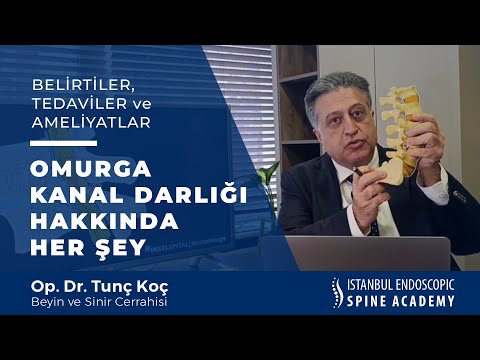
Screw-Free Closed Spinal Stenosis Surgery — Op. Dr. Tunc Koc

Why Is Open Surgery Not Preferred?

In conventional open surgery (laminectomy), muscles are cut and stripped back over a 5–15 cm length. Significant amounts of bone and ligamentous tissue are removed from the posterior spine. This results in:

  • Heavy bleeding and a prolonged hospital stay
  • Severe post-operative back pain
  • Muscles failing to regain their normal anatomy
  • Disruption of spinal stability and risk of spondylolisthesis
  • The need for a screw-and-plate system
Unfortunately, in our country screw-and-plate systems are used unnecessarily in a large number of cases. With the closed endoscopic method, the vast majority of patients do not require these systems at all.

Screw-Free Closed Endoscopic Method

In closed (endoscopic) spinal canal stenosis surgery, one or a few millimetre-scale incisions are made. Using special systems fitted with a camera at the tip, the thickened ligaments and calcified joints causing compression are removed without disturbing the healthy tissues or the anatomy of the muscles.

Full Endoscopic Spinal Canal Stenosis Surgery — Op. Dr. Tunc Koc

Advantages of the Closed Method

No Screws Required

Metal implant systems are not needed in the majority of cases

Muscles Are Preserved

The procedure is performed without cutting the muscles or disturbing their natural anatomy

Walk the Same Day

Patients can walk and go home on the day of surgery

Minimal Blood Loss

Blood loss that is incomparably less than with the open method

Local Anaesthesia Possible

In some cases, the procedure can be performed without general anaesthesia

Rapid Recovery

Short hospital stay and quick return to normal life

The Surgical Process

The procedure takes between 1 and 2 hours. After anaesthesia, the patient is positioned appropriately. Through a millimetre-scale incision, the camera and specialised instruments are placed at the target site. The ligamentous and bony tissue causing compression is removed. The majority of patients leave the hospital walking the following day.

Spinal canal stenosis surgeries result in a very high satisfaction rate among patients. The large majority of patients benefit significantly from the operation.
More Information

Detailed Information

Find more information about closed spinal canal stenosis surgery on the relevant page of Op. Dr. Tunc Koc's clinical website.

Go to Spinal Canal Stenosis Surgery Page →

About Full Endoscopic Spinal Stenosis Surgery

Can spinal stenosis surgery be performed without screws?
Yes. In the closed endoscopic method, the vast majority of patients do not require screw and plate systems. These may be necessary in select cases where the biomechanics of the spine are compromised.
When can a patient walk after spinal stenosis surgery?
With the closed method, patients can walk on the day of surgery or the following day. Recovery is much faster compared with open surgery.
How long does spinal stenosis surgery take?
With the closed endoscopic method, the procedure generally takes 1–2 hours.
Does every case of spinal stenosis require surgery?
No. Conservative treatments are applied for mild to moderate narrowing. Surgery is considered in cases of severe compression, muscle weakness or walking impairment.
What is the success rate of spinal stenosis surgery?
Spinal canal stenosis surgeries have high success rates. The large majority of patients experience significant pain reduction and an improvement in quality of life.

Get Expert Opinion for Spinal Stenosis

Op. Dr. Tunc Koc is one of Turkey's leading endoscopic spine surgeons. Get an expert consultation to evaluate your condition.