What Is Cervical Disc Herniation Surgery?
Cervical disc herniation surgery is a surgical procedure performed to relieve the pressure that the herniated cervical disc exerts on the nerves or spinal cord. During the operation, the herniated material from the disc is removed, the pressure on the nerves is relieved, and both the nerves and spinal cord are decompressed.
Op. Dr. Tunc Koc is among the first surgeons in Turkey to perform this method and has experience of more than 3,500 endoscopic operations.
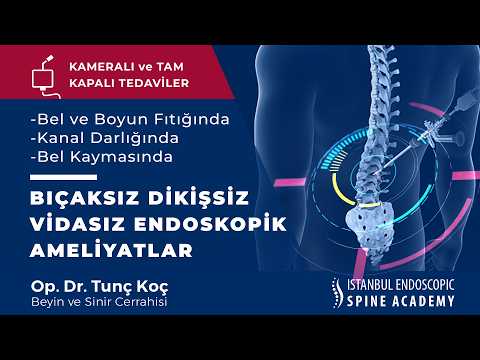
When Is Surgery Necessary?
- If neck, shoulder and arm pain has not resolved despite all treatments for more than 6 weeks
- If muscle weakness has developed in the arm or hand due to nerve compression
- If weakness in the arms or legs, or loss of balance, is present due to spinal cord compression
- If symptoms such as loss of bladder or bowel control have appeared
How Is Full Endoscopic Cervical Disc Herniation Surgery Performed?
Full endoscopic cervical disc herniation surgery is performed through a small millimetre-scale skin incision, using slender surgical instruments fitted with a camera at their tip. The surgeon views the herniated area under continuous camera guidance and removes only the herniated disc tissue — without completely removing the disc.
The operation can be approached from the front or back of the neck. The choice is determined by the location of the herniation and the surgeon's assessment. In both approaches, no screws, cages or any foreign material are used; the movement of the vertebrae is not restricted and neck mobility is fully preserved.
In conventional surgery, the disc is completely removed and replaced with a PEEK cage and screws, while the surrounding muscles and soft tissues are also cut and retracted. With the endoscopic method, healthy tissues are left completely untouched and the natural structure of the spine is fully maintained.

Post-operative Process
With the full endoscopic method, patients can comfortably stand, use stairs and sit a few hours after surgery. An overnight hospital stay is recommended for safety, although many patients can go home on the same day. Because muscles and surrounding tissues are left untouched, the recovery process is much shorter and more comfortable — 1–2 weeks' rest is sufficient for desk-based work, and 4–6 weeks for physically demanding work.
Advantages of the Closed Method
No Screws or Cages Required
No foreign material is implanted; the natural structure of the spine is preserved
No Damage to Muscles or Tissues
Surrounding muscles and healthy tissues are protected — not cut, not retracted
Home the Same Day
Discharge on the day of surgery or the following morning is possible
Millimetre Entry, No Scarring
Performed through a few millimetre opening — no scar, no sutures
Neck Mobility Preserved
Because the disc is not removed, the natural range of motion is fully maintained
Low Infection and Bleeding Risk
Compared with open surgery, the closed method carries a much lower risk of bleeding and infection
Duration and Anaesthesia
Cervical disc herniation surgery takes an average of 30 minutes to 1 hour. This varies depending on the number of levels, the surgeon's experience and the technique used. General anaesthesia is typically administered; a nerve block (local anaesthesia) may be preferred in certain cases.